
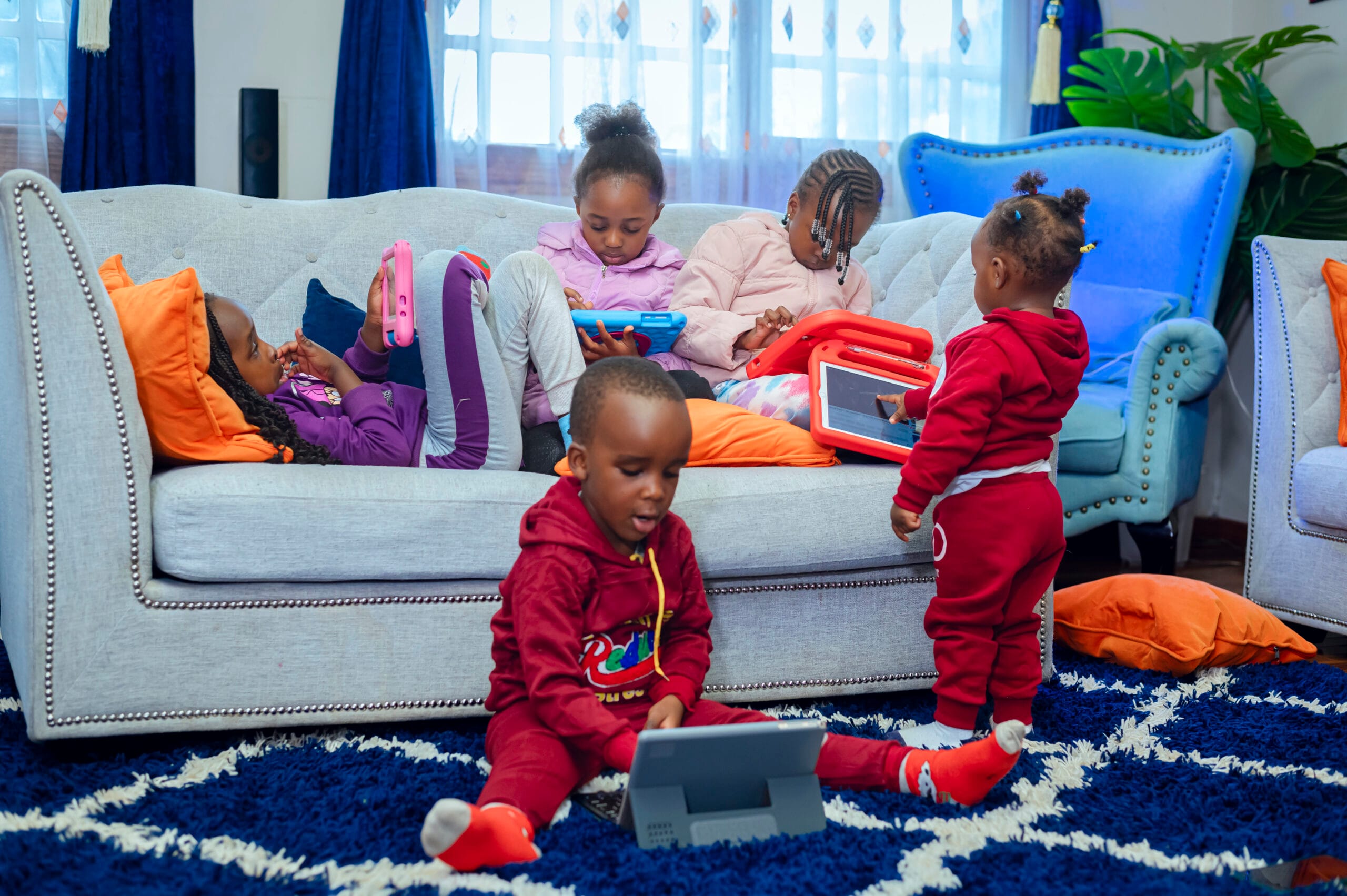
It’s a Saturday afternoon.
The living room is buzzing with activity.
One child is solving a puzzle. Another is exploring a learning game. The youngest is curious about what everyone else is doing and wants to join in.
To an outsider, it might look like screen time.
But look a little closer.
This isn’t just entertainment.
It’s learning happening right in the heart of the home.
For generations, we’ve thought of learning as something that happens in a classroom. Children go to school, sit at their desks, listen to their teachers, and come home with assignments to complete.
Home was where children rested.
School was where children learned.
But the world has changed.
Today, learning is no longer confined to four classroom walls.
It happens during a conversation at the dinner table. It happens while helping prepare a meal. It happens while building something with blocks, asking questions about the world, or exploring an educational activity on a tablet.
The boundaries between learning and everyday life are becoming increasingly blurred.
And that’s not a bad thing.
In fact, some of the most meaningful learning happens when children don’t even realise they’re learning at all.
Imagine a child exploring a maths game on a tablet.
To them, it’s simply a challenge they want to solve.
They’re trying to beat a level. They’re having fun.
But beneath the surface, they’re strengthening their memory, improving their concentration, and developing problem-solving skills.
Another child might be listening to an educational story that introduces new vocabulary and ideas. A younger sibling watches curiously, eager to participate.
What looks like ordinary family time is quietly becoming an opportunity for growth.
That’s the beauty of learning at home.
It feels natural.
It feels comfortable.
And because children feel relaxed in their home environment, they are often more willing to explore, experiment, and learn independently.
This shift is particularly important in today’s educational landscape.
The Competency-Based Curriculum (CBC) encourages learners not only to acquire knowledge but also to apply it in real-life situations. Children are expected to think critically, communicate effectively, solve problems, and become independent learners.
These are not skills that develop only during school hours.
They grow through daily experiences.
A child who learns to follow instructions while completing an educational activity is building self-efficacy.
A child who works through a challenge in a learning game is developing resilience and critical thinking.
A child who discovers something new and excitedly shares it with their family is strengthening communication skills.
The learning continues long after the school bell rings.
Of course, many parents worry about the growing role of technology in their children’s lives.
It’s a valid concern.
We hear a lot about reducing screen time, limiting devices, and protecting children from digital distractions.
But perhaps the conversation should focus less on whether children are using screens and more on what they are doing with them.
Because not all screen time is equal.
There is a difference between passive consumption and active engagement.
There is a difference between endless scrolling and purposeful exploration.
When technology encourages children to think, create, discover, and solve problems, it becomes more than entertainment.
It becomes a learning tool.
This is where ElimuTab fits naturally into the modern family learning space.
ElimuTab is designed around a simple idea: children learn best when learning feels engaging and enjoyable.
That’s why every tablet comes loaded with educational games, interactive activities, stories, and learning content that support a child’s development while keeping them interested and motivated.
Children aren’t simply staring at a screen.
They’re answering questions.
They’re solving challenges.
They’re exploring ideas.
They’re learning through play.
And because the experience is enjoyable, learning becomes something they choose to do rather than something they feel forced to do.
For parents, that means greater confidence that screen time is being used purposefully.
For children, it means discovering that learning can happen anywhere.