
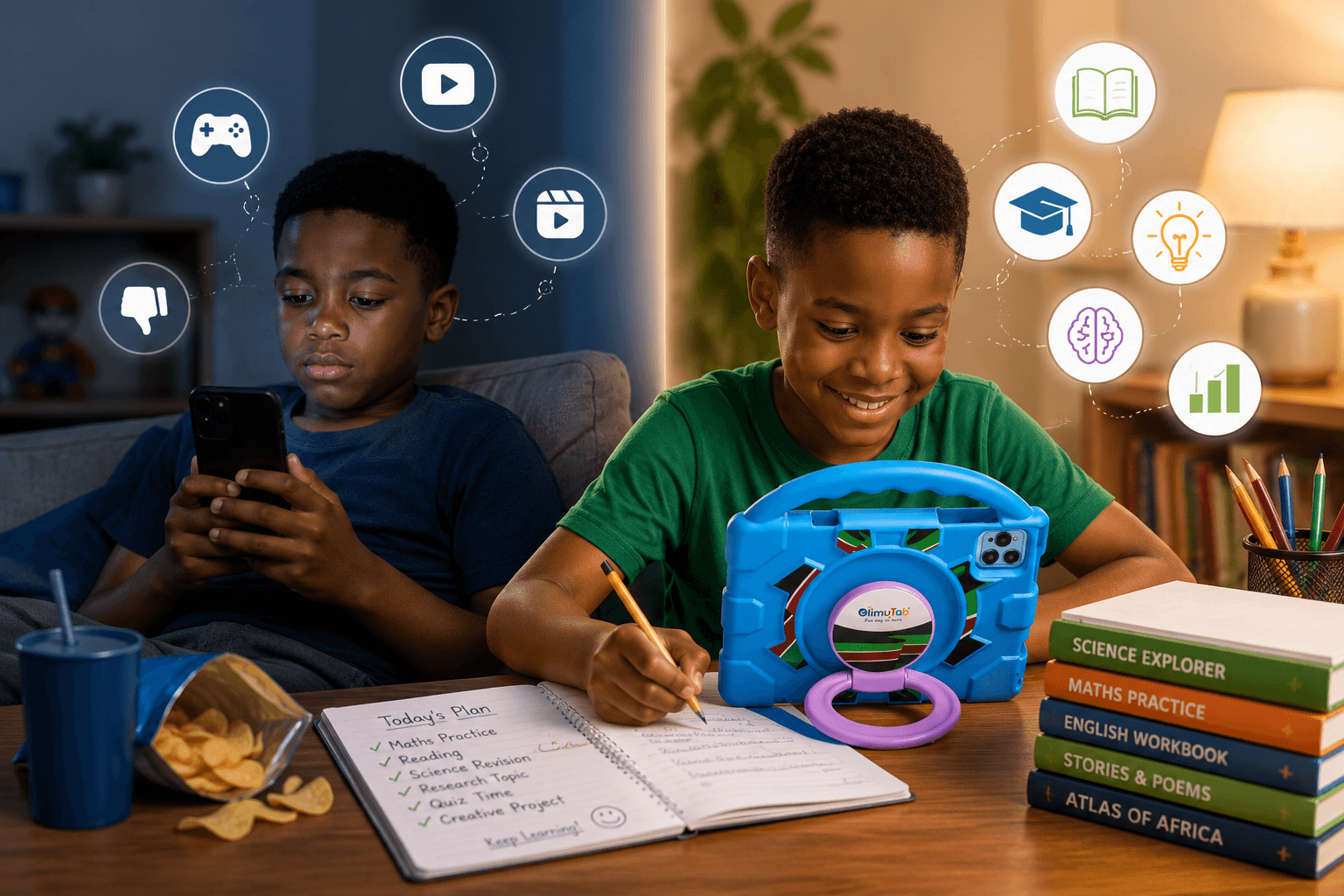
A new kind of digital divide is emerging.
It is not only between children who have devices and children who do not.
It is between children who use screens with purpose and children who use screens passively.
Because today, many children already have access to screens. They use phones, tablets, TVs, laptops, and school devices. Some use them for learning. Some use them mainly for entertainment. Some move from cartoons to games to short videos without any structure. Others use screens to read, revise, research, code, create, and explore ideas.
That difference matters.
The screen itself is not the problem.
The purpose is.
Common Sense Media’s 2025 Census found that 40% of children have a tablet by age 2, and nearly 1 in 4 children have a personal cellphone by age 8. The same report found that children aged 8 and under spend about 2.5 hours a day with screen media.
This tells us something important.
Screens are no longer waiting for children in the future. They are already in the home, in the car, in the bedroom, in the classroom, and in the child’s daily routine.
So the question for parents is no longer simply:
“Should my child use a screen?”
A better question is:
“What is my child becoming through this screen?”
Because not all screen time is equal.
One hour spent watching random videos is not the same as one hour spent reading a story, practising maths, learning a new language, researching a school topic, or building a creative project.
One screen can make a child passive.
Another screen can make a child curious.
One screen can distract a child from schoolwork.
Another screen can support revision.
One screen can expose a child to unsafe content.
Another screen can help parents guide what the child accesses.
The difference is not the device alone.
The difference is structure, content, supervision, and purpose.
UNESCO’s 2023 Global Education Monitoring Report makes this point clearly. Technology can support access, equity, inclusion, and quality in education. But it can also become harmful when it is not used appropriately or when it distracts learners from meaningful learning.
This is something every parent understands.
A screen can help a child learn.
A screen can also steal a child’s focus.
That is why the conversation must move beyond fear and beyond blind excitement.
We should not treat all screen use as dangerous.
We should also not treat all screen use as educational.
The real work is helping children build better digital habits.
At home, this starts with simple questions.
What is the screen being used for?
These questions help parents move from control to guidance.
Because the goal is not just to reduce screen time.
The goal is to improve screen time.
A child who only uses screens for entertainment may become good at swiping, skipping, and watching. But a child who uses screens for purposeful learning can build reading habits, digital confidence, curiosity, problem-solving, creativity, and independent study skills.
That is the new divide.
Passive screen time keeps the child busy.
Purposeful screen time helps the child grow.
This matters even more as digital learning expands in Kenya and across Africa.
UNICEF Kenya reported that by December 2025, 363 schools had been connected to internet under the Kenya Last Mile Connectivity Programme, benefiting more than 277,000 learners. More than 4,400 teachers had also begun integrating digital tools into classroom instruction.
This is encouraging.
But access is only the beginning.
A connected school still needs guided learning.
A tablet in the home still needs structure.
An online platform still needs safe use.
A child with a device still needs a parent, teacher, or caregiver who cares about what happens on that screen.
The future of learning will not be built by screens alone.
It will be built by the choices we make around those screens.
For parents, the practical shift is simple:
Do not only ask, “How long has my child been on the screen?”
Also ask, “What has my child done with the screen?”
Did they read?
Did they revise?
Did they practise?
Did they create?
Did they learn something they can explain?
Did the screen move them closer to their potential or further from their focus?
This is where purposeful digital parenting begins.
Children do not only need access to technology. They need access to the right content, safe environments, structured routines, and adults who help them use technology wisely.
Because in the end, the best screen is not the one that keeps a child quiet.
It is the one that helps a child think, learn, and grow.
The screen is not the problem.
The purpose is.