
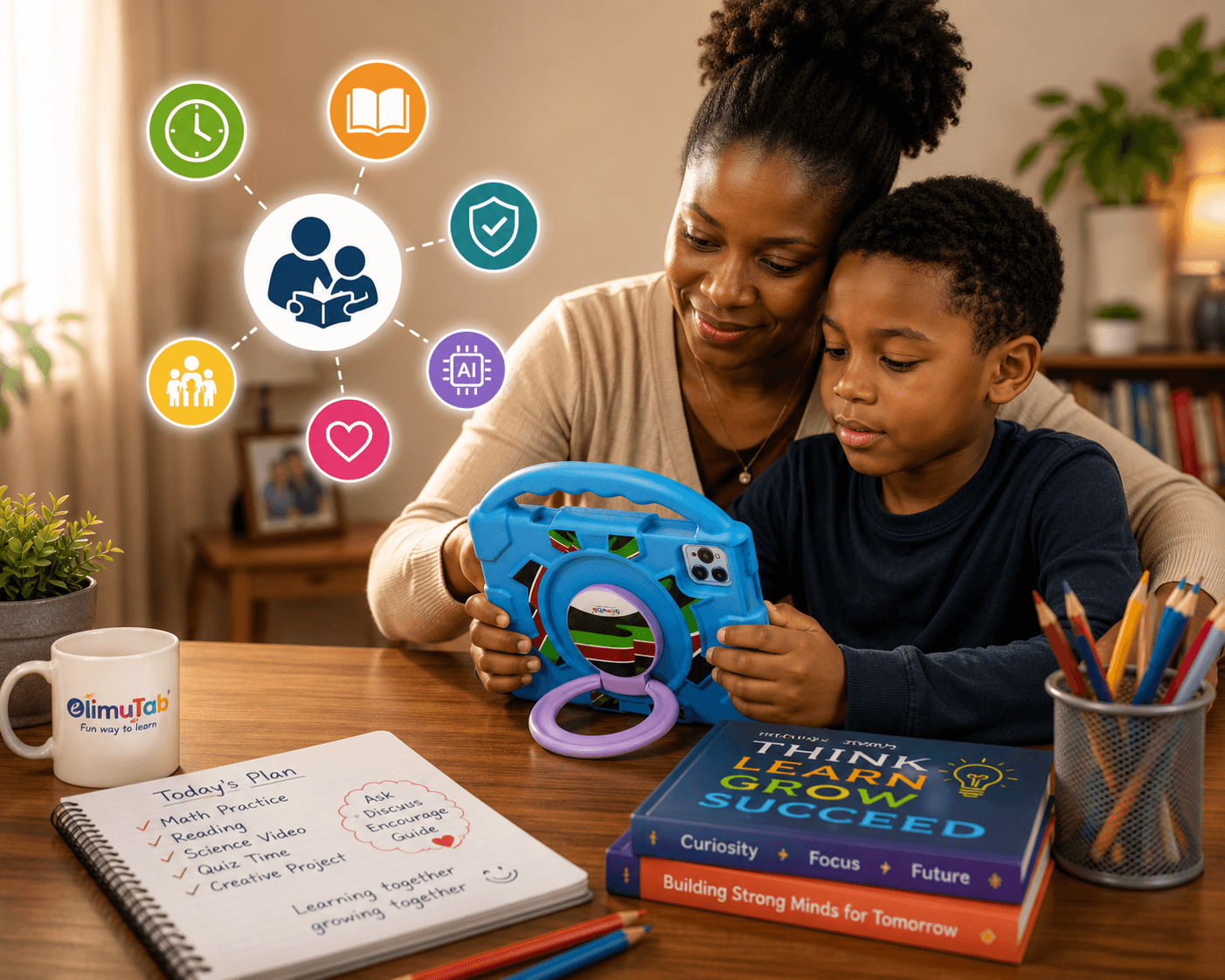
Technology can open the door to learning.
But it cannot walk the child through that door alone.
Today, children are growing up surrounded by screens, apps, videos, learning platforms, online classes, AI tools, games, and digital content. For many parents, the question is no longer whether their child will use technology.
They already are.
The bigger question is:
Who is guiding that use?
Because the best learning technology still needs a parent.
A tablet can provide educational content.
An app can help a child practise maths.
A video can explain a difficult science concept.
An AI tool can help with research or revision.
A digital library can introduce a child to hundreds of books.
But none of these things automatically creates discipline, curiosity, consistency, or wisdom.
That is where parents still matter.
The UNESCO notes that parental involvement, both at home and in school, can create long-lasting benefits for children from early childhood into adulthood. That is an important reminder in the digital age. Even as learning tools become smarter, the home environment still shapes how children learn.
Technology can support learning.
Parents shape the habit of learning.
A child may have access to the best learning device, but if there is no routine, the screen can quickly become another source of distraction. One minute the child is revising. The next minute they are watching unrelated videos, opening games, switching apps, or simply scrolling.
This is why structure matters.
The UNESCO’s work on digital devices and learning warns that digital distraction is not just a small inconvenience. It has a real relationship with learning outcomes. In simple terms, when digital tools are not guided, they can interrupt focus instead of supporting learning.
Many parents already see this at home.
A child says they are using the tablet for homework, but the parent is not sure what is actually happening.
A phone is given for “research,” but it turns into games and videos.
A child spends hours on a screen, but cannot clearly explain what they learned.
The screen is always on, but the learning is not always clear.
This does not mean technology is bad.
It means technology needs parenting.
In the age of digital learning, the parent’s role is not to know every app, every platform, or every new technology. The parent’s role is to provide direction.
Children need adults who ask simple but important questions:
What are you learning today?
Which app or resource are you using?
Can you explain what you just learned?
How long will you use the screen?
Is this schoolwork, practice, reading, creativity, or entertainment?
What will you do after screen time?
These questions turn screen use into guided learning.
They also teach children something bigger than technology. They teach responsibility.
UNICEF reminds us that digital tools should enhance, not replace, human connection, play, and social interaction. This matters because children do not only learn from content. They learn from conversations, routines, encouragement, boundaries, and real-life experiences.
A child still needs someone to connect what they see on a screen with the world around them.
That is parenting.
And it cannot be downloaded.
This is why parents should not only focus on limiting screen time. They should also focus on improving screen time.
The American Academy of Pediatrics no longer gives one fixed screen-time number that applies to every child and teen. Instead, it encourages families to create media habits that fit the child’s age, health, sleep, schoolwork, and family routine.
That is a more realistic approach.
Every home is different. Every child is different. But every child benefits from guidance.
For parents, this can start with a simple weekly rhythm.
Set clear learning times.
Create screen-free moments, especially during meals, homework breaks, and bedtime.
Use parental controls where needed.
Check what your child is accessing.
Encourage reading, revision, creativity, and problem-solving.
Balance digital learning with play, rest, chores, conversation, and family time.
Most importantly, stay involved.
A learning device should not become a digital babysitter. It should become part of a bigger learning environment at home.
Technology is only one part of the learning journey.
At ElimuTab, we believe the future of learning is not about giving children screens and stepping away. It is about helping children use screens with purpose, safety, structure, and confidence.
Because the best learning technology does not replace the parent.
It works better when the parent is present.
The best learning technology still needs a parent.