
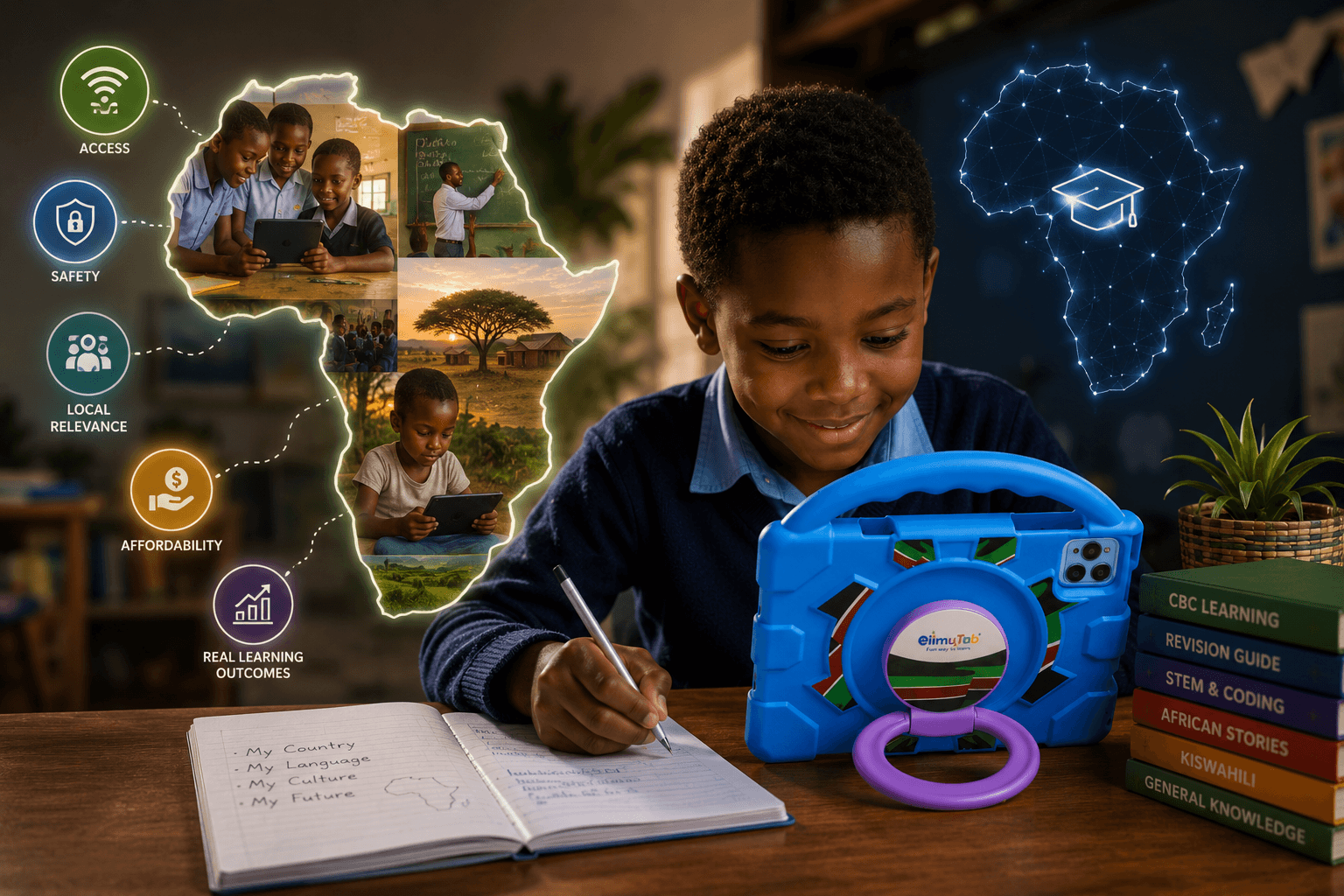
At ElimuTab, we believe Africa’s children deserve digital learning tools that understand where they are, what they need, and who they can become.
Classrooms are becoming more digital. Children are using tablets, learning apps, online libraries, coding platforms, and AI tools. Teachers are exploring new ways to teach. Parents are trying to understand what kind of technology is safe, useful, and worth investing in.
But as Africa enters this new chapter of digital learning, we must ask an important question:
Are we building the future of education for our children, or are we simply copying someone else’s?
Because Africa should not copy-paste the future of learning.
For Kenya, this means EdTech must understand CBC learning needs, parental concerns, screen safety, school revision, affordability, internet gaps, home learning routines, and the role of teachers. It must serve both the child in a well-connected urban home and the child in a community where internet access is limited.
Technology can open powerful opportunities for children. It can improve access to books, revision materials, videos, assessments, languages, coding, creativity, and research. It can help a child in a rural home access learning support that was once only available in better-resourced schools. It can help teachers bring lessons to life. It can help parents support learning at home.
But technology only works well when it fits the reality of the learner.
A solution designed for a fully connected classroom in Europe or America may not work the same way in a Kenyan home, a rural school, a low-income community, or a classroom where teachers are handling large numbers of learners with limited resources.
This is why Africa needs its own EdTech conversation.
Not because global technology is bad.
But because local context matters.
UNESCO’s 2023 Global Education Monitoring Report reminds us that access is still unequal. Globally, only 40% of primary schools, 50% of lower secondary schools, and 65% of upper secondary schools are connected to the internet. The report also warns that education technology should be judged by whether it improves learning outcomes, not by how modern it looks.
That point is important for parents.
A device alone is not education.
An app alone is not learning.
Internet access alone is not progress.
AI alone is not wisdom.
The real question is:
Does this technology help the child learn better?
For African families, EdTech must answer practical questions.
Can it work when internet is unreliable?
Is the content relevant to the curriculum?
Can parents control what the child accesses?
Is it affordable?
Does it support local learning needs?
Can it help children revise, read, practise, and build skills?
Can it protect children from unsafe content?
Can it support teachers instead of replacing them?
Can it work in the real conditions of African homes and schools?
These are not small details.
They are the difference between technology that looks impressive and technology that actually helps a child.
A 2025 study on teachers in Sierra Leone found that although 85% of Sub-Saharan Africa’s population is covered by mobile broadband signal, only 37% use the internet. One major reason is the cost of data. The same study found that only 2% of comparable web search results contained content from Sierra Leone.
That tells us something very important.
Access to the internet does not automatically mean access to relevant learning.
A child can search online and still find examples, stories, references, and explanations that do not reflect their country, their classroom, their language, their curriculum, or their daily life.
This is where local design matters.
An African child should not have to learn only through examples that feel far away from their world. They should be able to see learning connected to their environment, their school system, their language realities, their culture, and their future.
Parents should care about this because children do not only learn facts from technology. They also learn what is important, what is normal, whose examples matter, whose stories are visible, and whose knowledge is valued.
That is why the future of EdTech in Africa cannot simply be about importing devices, apps, and platforms.
It must be about designing learning experiences that fit African children.
It must also understand parents.
Many parents are not asking for complicated technology. They are asking for safer screens, useful content, school support, revision tools, parental control, and learning that makes sense for their child’s age.
They want technology that helps, not technology that confuses.
They want their children to be ready for the future, but not exposed to every risk that comes with the digital world.
That is a fair expectation.
Africa’s EdTech conversation should therefore be built around five things:
- Access.
- Safety.
- Local relevance.
- Affordability.
- Real learning outcomes.
When these five things come together, technology becomes more than a screen. It becomes a learning bridge.
But when they are ignored, technology can widen the same gaps it was meant to close.
The future of learning in Africa should not be copied blindly.
It should be built carefully.
Because the goal is not just to bring technology into education.
The goal is to bring the right technology into the right learning environment, with the right guidance, for the right outcomes.
Africa should not copy-paste the future of learning.
Africa should help shape it.