
Let’s be honest.
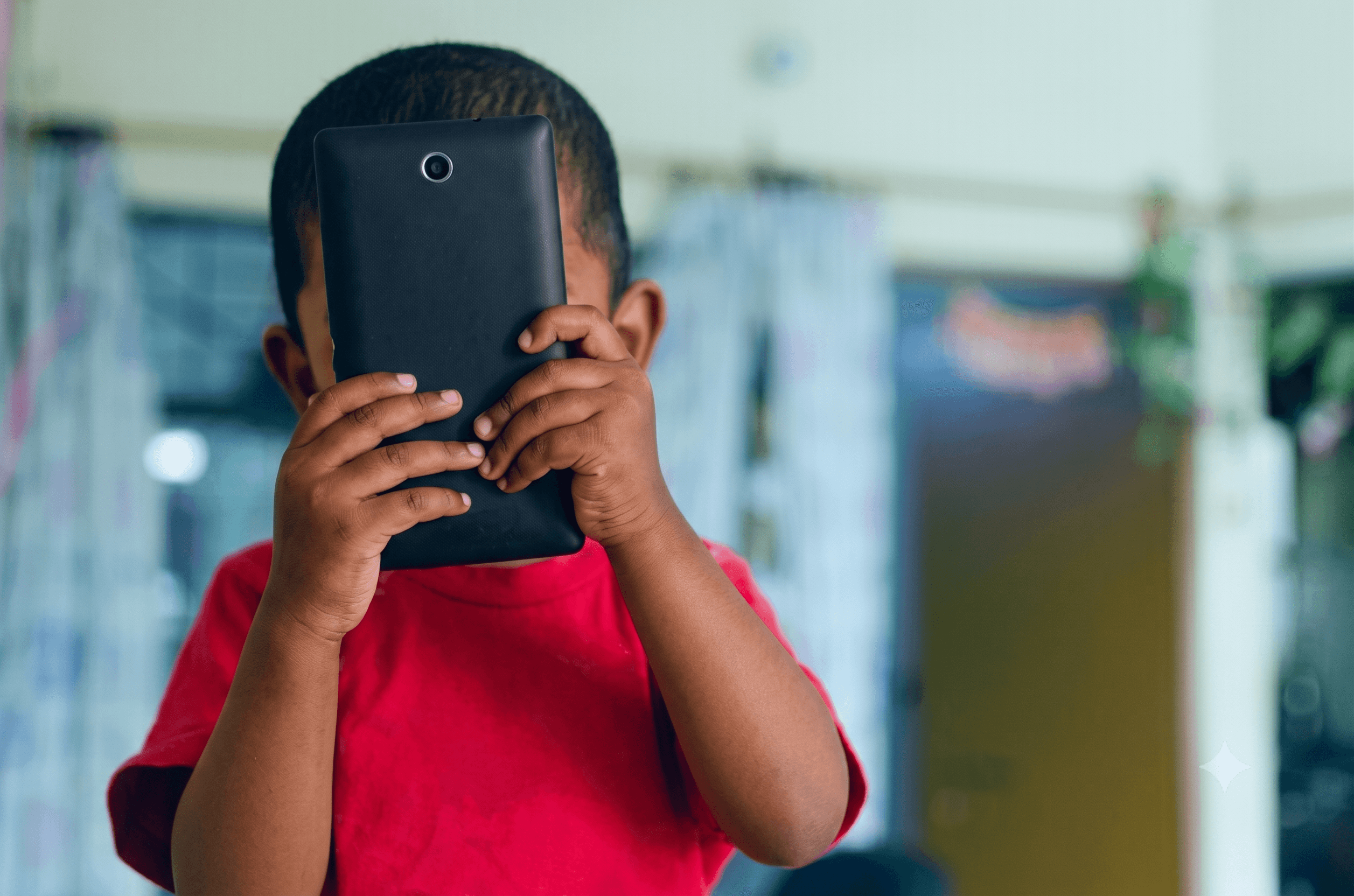
Many parents have handed their child a phone.
Maybe you were busy. Maybe they were restless. Maybe they wanted to watch something, play a game, or “search for homework.”
It feels harmless.
But here is the quiet problem:
Your phone was not built for your child’s learning.
It was built for you.
Your calls.
Your WhatsApp messages.
Your emails.
Your banking apps.
Your social media.
Your notifications.
Your browsing history.
So when a child uses your phone, they are not entering a learning space. They are entering an adult device full of distractions.
One notification pops up.
One ad appears.
One suggested video leads to another.
One small search becomes random browsing.
And just like that, learning disappears.
Not because your child is doing something wrong.
Because the device was not designed for them.
Children Need More Than a Screen
Screens are already part of childhood. Common Sense Media’s 2025 Census found that 40% of children have a tablet by age 2, and nearly 1 in 4 children have a personal cellphone by age 8.
In Kenya, smartphones are also everywhere. The Communications Authority of Kenya reported that smartphone penetration reached 83.5% by June 2025.
So the issue is no longer whether children will use screens.
They will.
The real question is:
What kind of screen are we giving them?
A phone is built for communication, entertainment, social media, videos, calls, and apps. That is useful for adults, but risky for children.
A child does not need adult notifications, open browsing, random apps, pop-ups, and endless distractions mixed into their learning time.
They need a guided space.
A Generic Tablet Is Not Always Enough
Some parents think, “I’ll just buy a normal tablet.”
That may separate the child from your phone, but it does not automatically solve the problem.
A generic tablet can still become a bigger entertainment screen if it is not set up properly.
Games.
Videos.
Downloads.
Ads.
Open internet.
Random apps.
The screen may be bigger, but the problem remains the same.
A learning device must be built with purpose.
Why ElimuTab Is Different
ElimuTab is not just another screen.
It is built as a learning companion for children.
It gives children access to educational apps, digital books, revision support, language learning, coding, creativity tools, and age-appropriate content.
More importantly, it gives parents control.
With ElimuSafe parental control, parents can guide what the child accesses, manage apps, support safer browsing, and set healthier screen-time boundaries.
That means your child is not just holding a device.
They are using a screen designed for learning.
The Simple Difference
A phone keeps your child connected.
A generic tablet keeps your child occupied.
ElimuTab helps your child learn with purpose.
That is the difference.
So before handing over your phone, ask yourself:
Is this helping my child learn?
Can I control what they access?
Is this screen safe for their age?
Or am I just giving them the nearest device?
No parent gets it perfect every day.
But the screen we give children matters.
Your phone is powerful.
But it was not built for your child’s learning.
ElimuTab was.