Artificial Intelligence is no longer something children will meet “in the future.”
It is already here.
It is helping people write, research, translate, solve problems, create images, summarize information, plan lessons, and learn faster. Around the world, schools, teachers, parents, and policymakers are now asking the same question:
Should children use AI?
But maybe that is not the best question.
A better question is:
Are we preparing children to use AI wisely?
Because whether we like it or not, today’s children are growing up in a world where AI will shape how they study, work, communicate, create, and solve problems. The goal should not be to make children dependent on AI. The goal should be to raise children who can think clearly, ask better questions, verify information, use technology responsibly, and still develop strong human skills.
The OECD’s Digital Education Outlook 2026 makes this point clearly. Generative AI can support learning when it is guided by clear teaching principles. But when children simply use AI to do the thinking for them, they may complete the task without actually learning.
That is an important warning for parents.
A child can use AI to get an answer quickly. But did they understand the question?
A child can use AI to write a paragraph. But did they learn how to express an idea?
A child can use AI to solve a problem. But did they build the thinking skill behind the solution?
This is where parental guidance becomes important.
AI should not replace thinking. It should support thinking.
Globally, teachers are already using AI. OECD data shows that in 2024, 37% of lower secondary teachers used AI for their work. 57% agreed that AI helps write or improve lesson plans. At the same time, 72% believed AI can harm academic integrity by allowing students to pass off work as their own.
This shows both sides of the AI conversation.
AI can help.
AI can also harm.
The difference is guidance.
For parents, this means we cannot treat AI like just another app. AI is different because it does not only entertain children. It can answer them, guide them, influence them, and sometimes mislead them. That is why UNESCO recommends a human-centred and age-appropriate approach to generative AI in education, with clear attention to privacy, safety, and responsible use.
UNICEF also reminds us that AI systems used by children must protect their rights, safety, privacy, well-being, and development. Children should not just be users of technology. They should be protected, guided, and prepared.
So what does this mean at home?
First, children need digital guidance, not digital fear.
Banning every new technology may feel safe in the short term, but it does not prepare children for the world they are entering. At the same time, giving children unlimited access to powerful tools without supervision is risky.
The right approach is guided exposure.
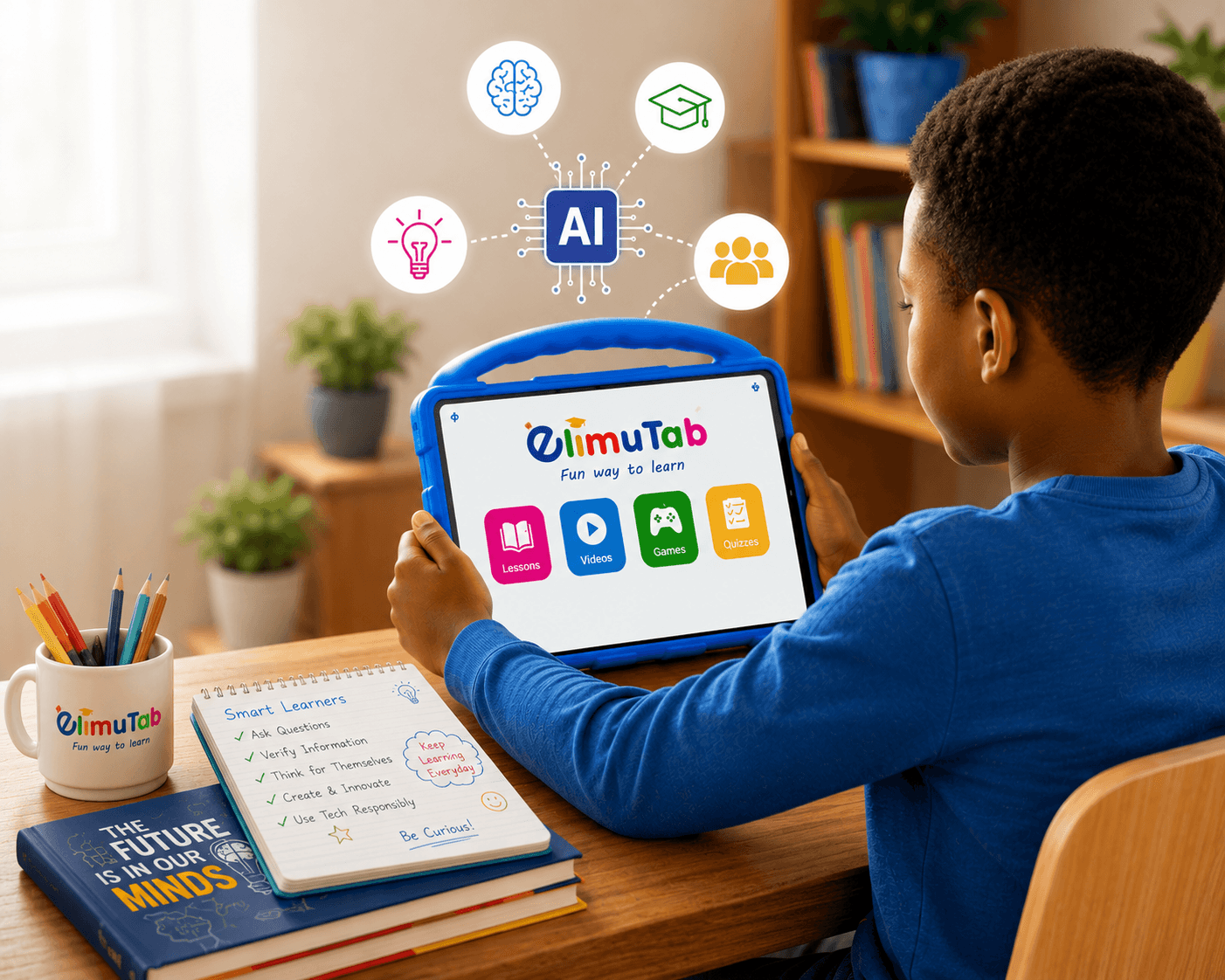
Parents can start by teaching children simple AI habits:
Do not copy everything AI gives you.
Always ask: “Does this answer make sense?”
Use AI to explain, not just to complete homework.
Compare AI answers with books, teachers, and trusted learning resources.
Never share private information with AI tools.
Remember that AI can be wrong.
These are not just technology skills. They are thinking skills.
And thinking skills will matter even more in the future.
The World Economic Forum’s Future of Jobs Report 2025 projects that nearly 40% of job skills will change by 2030. Skills linked to AI, data, and technology will grow quickly. But the same report also highlights that human skills like analytical thinking, creativity, resilience, leadership, and collaboration will remain critical.
That should encourage every parent.
The future will not only belong to children who can use machines.
It will belong to children who can think with clarity, learn continuously, create original ideas, work with others, and use technology responsibly.
In Kenya, the digital learning conversation is already growing. UNICEF Kenya reported that by December 2025, 363 schools had been connected to internet under the Kenya Last Mile Connectivity Programme, benefiting more than 277,000 learners and supporting thousands of teachers to integrate digital tools into learning.
This matters because access is improving.
But access alone is not enough.
A child with access to technology still needs structure.
A child with access to AI still needs values.
A child with access to information still needs wisdom.
That is where parents come in.
Parents do not need to be AI experts to guide their children. They only need to stay involved.
Ask your child what they are learning.
Ask them how they found the answer.
Ask them to explain it in their own words.
Ask them what they think, not just what the screen says.
Create rules around when, where, and how learning devices are used.
AI is entering education, but it should not enter our children’s lives without guidance.
The future of learning will not be about choosing between children and technology.
It will be about helping children use technology in ways that protect their curiosity, strengthen their thinking, and prepare them for a changing world.
At ElimuTab, we believe the best screen is not the one that keeps a child busy.
It is the one that helps a child learn with purpose.
Welcome to Elimu Notes — weekly notes on education, technology, AI, and the future of learning.