Your child comes home with homework.
A few minutes later, they say, “I’m done.”
The paragraph is clean. The answer sounds smart. The grammar is almost too perfect.
You ask one simple question:
“Can you explain it to me?”
Then comes the pause.
That pause is where the real AI conversation begins.
Because AI is already changing how children learn. It can explain a difficult topic, summarise notes, translate words, generate practice questions, and help with revision. For a child who is stuck, that can be useful.
But AI can also make schoolwork look complete before learning has actually happened.
That is what parents need to understand.
The danger is not that children will use AI.
They will.
The danger is that they may use AI to skip the thinking part.
And learning does not happen when a child only gets the answer. Learning happens when they struggle with the idea, ask questions, make mistakes, correct themselves, and finally understand enough to explain it in their own words.
AI can support that process.
Or it can quietly remove it.
The OECD’s Digital Education Outlook 2026 shows how quickly AI is entering education. In 2024, 37% of lower secondary teachers used AI for their work, and 57% agreed that AI helps write or improve lesson plans.
So AI is not waiting outside the classroom.
It is already inside the learning process.
But the same OECD report also found that 72% of teachers believe AI can harm academic integrity by allowing students to pass off AI-generated work as their own.
That statistic matters because it captures the tension parents are already beginning to feel.
AI can help a child learn faster.
It can also help a child look like they learned.
Those are not the same thing.
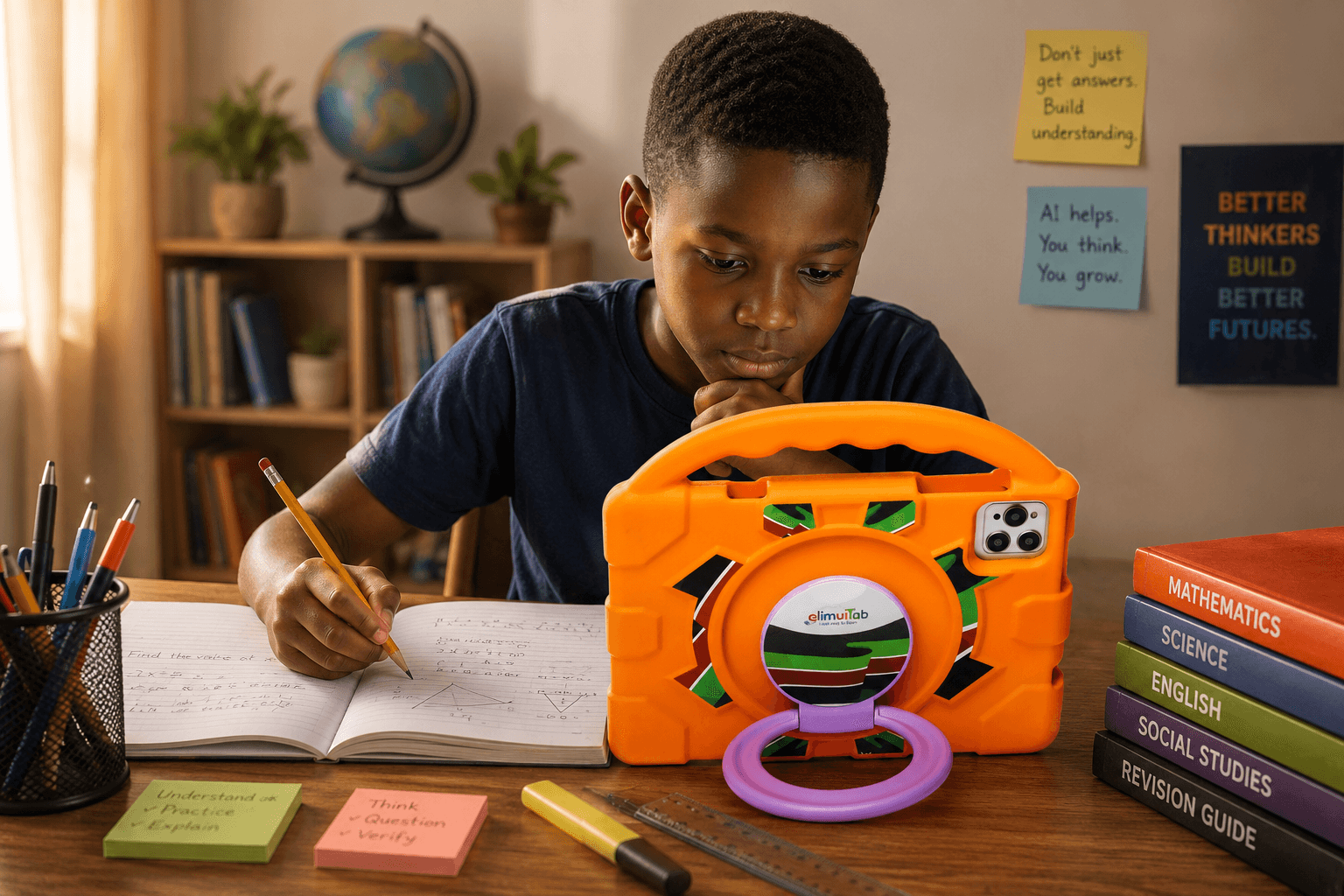
A child who asks AI, “Explain fractions using simple examples,” is using AI as a tutor.
A child who asks AI, “Do my maths homework,” is using AI as an escape route.
A child who asks AI to generate questions for revision is practising.
A child who copies an AI essay without understanding it is pretending.
Same tool.
Different habit.
And habits matter.
Because the children who succeed in an AI-powered world will not simply be the ones who know which button to press. They will be the ones who know how to ask better questions, check answers, compare information, form opinions, create original work, and explain their thinking clearly.
The World Economic Forum’s Future of Jobs Report 2025 says 39% of workers’ core skills are expected to change by 2030. Among the skills becoming more important are analytical thinking, creativity, technological literacy, resilience, and problem-solving.
That should reassure parents and challenge them at the same time.
AI may change the tools children use.
But it does not remove the need for strong minds.
In fact, it makes strong thinking more important.
Because when answers become easy to generate, the real advantage moves to the child who can judge whether the answer is useful, accurate, fair, original, and well understood.
That kind of child does not just copy.
They question.
They ask, “Is this true?”
They ask, “Can I explain this differently?”
They ask, “What is missing?”
They ask, “Where else can I confirm this?”
They ask, “What do I think?”
That is the difference between using AI and being used by AI.
For parents, the answer is not panic.
It is guidance.
You do not need to become an AI expert overnight. You do not need to understand every tool your child may use. But you do need to stay close enough to the learning process to know whether your child is thinking or simply submitting polished work.
Start with better questions at home.
Instead of only asking, “Have you finished your homework?”
Ask:
“What did you understand?”
Instead of asking, “Did AI help you?”
Ask:
“How did it help you?”
Instead of saying, “Don’t use AI.”
Say:
“Use it to understand, then explain it in your own words.”
That small shift matters.
It teaches the child that the goal is not just to finish the work. The goal is to own the learning.
Because the future will have many children who can get quick answers.
But quick answers will not be enough.
The real advantage will belong to children who can think clearly, question confidently, create honestly, and use technology with discipline.
AI is powerful.
But thinking is still the advantage.