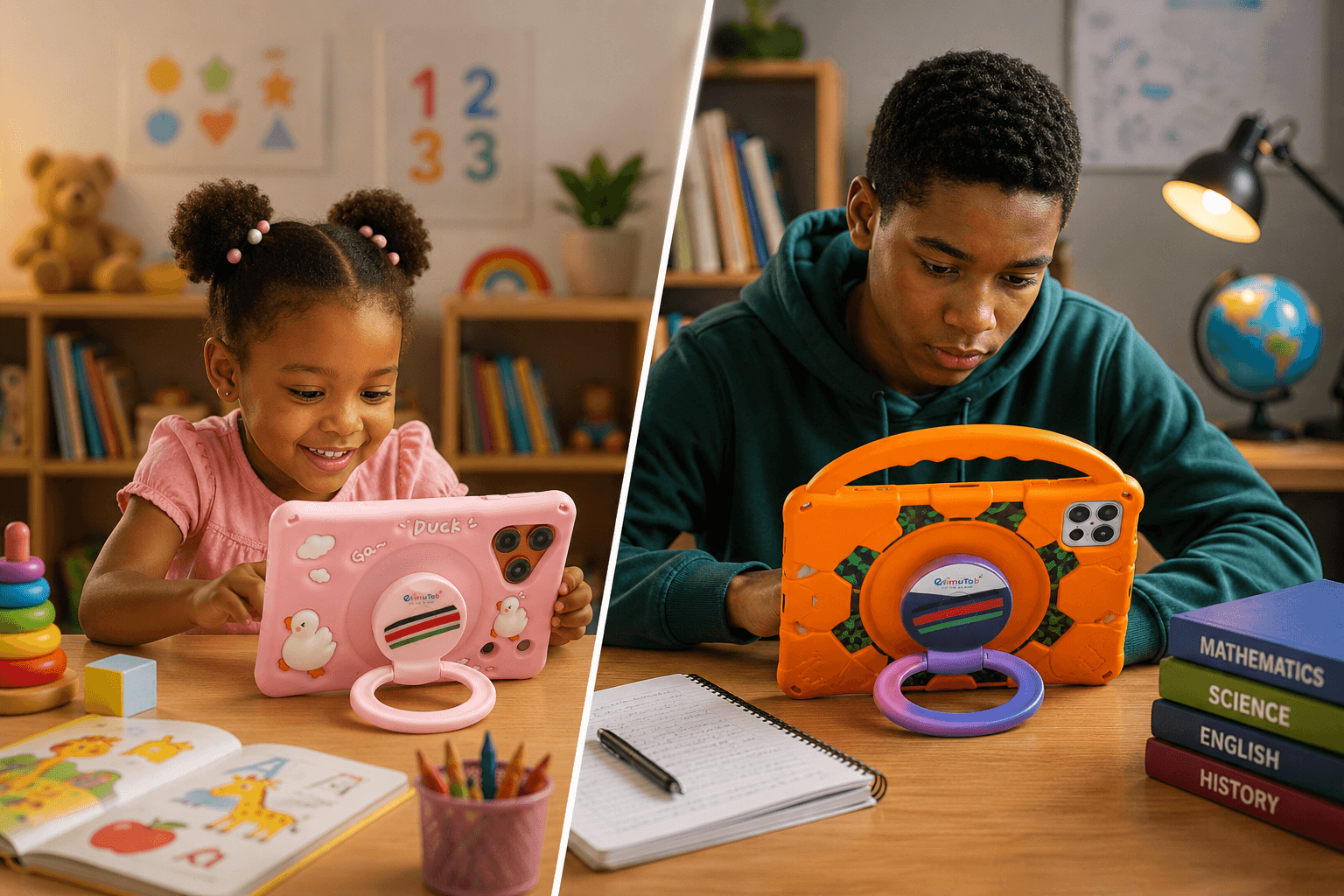
A 4-year-old and a 14-year-old can both use a tablet.
But they should not be on the same learning journey.
That sounds obvious.
Yet in many homes, children are handed the same screen, the same apps, the same videos, and sometimes the same internet. The younger child is exposed to content they are not ready for. The older child is given content that no longer challenges them.
Both children lose.
One is pushed too far, too early.
The other is held too far behind.
That is why age-appropriate device and content matters.
In this case, Jane is 5 and the elimuTab ET04 Pro is the perfect companion. For James, aged 13, the elimuTab ET03 Max has more advanced study and productivity content.
One Screen Does Not Mean One Experience
A tablet is just the tool.
The real question is what the child meets inside it.
For a younger child, a good learning experience may look like colours, sounds, letters, counting, simple stories, songs, shapes, picture books, and guided play.
At that age, learning is about discovery.
The child is building language, attention, memory, coordination, confidence, and curiosity.
A 4-year-old does not need long notes, exam revision, open browsing, or complicated apps. They need simple, safe, playful learning that introduces the world gently.
But a 14-year-old needs something very different.
They may need revision tools, subject notes, research support, digital books, quizzes, coding, creativity tools, productivity apps, and career exposure. They are not just learning letters and numbers. They are building independence, discipline, reasoning, and confidence for higher learning.
So yes, it may be one screen.
But it should not be one experience.
Content That Is Too Advanced Can Frustrate a Child
Sometimes parents believe giving a child “harder” content will make them smarter faster.
Not always.
If the content is too far above the child’s level, it can create frustration. The child may feel lost, bored, or defeated. Instead of building confidence, the screen starts to feel like pressure.
A young child who cannot follow instructions may start tapping randomly.
A child who does not understand the lesson may switch to games.
A learner who keeps failing questions may begin to believe they are not good at the subject.
That is not learning.
That is poor matching.
A good learning journey should stretch a child, not crush them.
The content should be slightly challenging, but still possible with effort and guidance.
That is how confidence grows.
Content That Is Too Simple Can Waste Time
The opposite problem is also real.
Older children can quickly outgrow basic content.
If a 12-year-old is still using apps meant for early learners, they may look busy, but they are not being challenged. The screen becomes comfortable, but not useful.
And comfort is not the same as progress.
Older children need content that asks more from them.
They need to read deeper.
Think harder.
Solve better.
Research safely.
Create more.
Revise seriously.
Build digital skills.
Take responsibility for their learning.
If the content is too easy, the child may enjoy it, but they may not grow from it.
That is why parents should not only ask, “Is my child using the tablet?”
They should ask:
“Is this content right for my child’s age and level?”
Safety Also Changes With Age
Age-appropriate content is not only about schoolwork.
It is also about safety.
A preschool child needs a highly controlled digital environment. They should not be freely browsing, downloading apps, or moving from one platform to another without guidance.
A younger learner needs simple boundaries.
What they can open.
What they can watch.
How long they can use the screen.
Which apps they can access.
What content is blocked.
Older children also need safety, but the approach changes.
They need more conversations about online behaviour, privacy, misinformation, AI use, cyberbullying, scams, and digital responsibility.
A teenager may need more independence than a 5-year-old.
But independence should not mean no guidance.
It should mean guided responsibility.
That is the balance parents need to build.
The Right Content Builds the Right Habits
Children do not only learn from what they are taught.
They also learn from the habits their tools create.
If a child’s tablet is filled with random entertainment, the habit becomes passive consumption.
If it is filled with reading, revision, practice, creativity, and safe exploration, the habit becomes purposeful learning.
That is why age-appropriate content matters so much.
For younger children, the habit may be:
Listen.
Repeat.
Identify.
Count.
Read simple words.
Explore safely.
For middle learners, the habit may be:
Practise.
Revise.
Take quizzes.
Read stories.
Build vocabulary.
Try coding basics.
For older learners, the habit may be:
Research.
Analyse.
Create.
Revise independently.
Use productivity tools.
Prepare for exams.
Ask better questions.
Different ages need different learning muscles.
The right content helps build those muscles at the right time.
A Simple Way to Think About It
When choosing learning content, parents can ask five simple questions:
Is it safe for my child’s age?
Is it easy enough to understand?
Is it challenging enough to help them grow?
Does it support what they are learning in school?
Can my child explain what they learned after using it?
If the answer is yes, the content is probably useful.
If the child is only tapping, watching, or guessing without understanding, something needs to change.
One Screen. Different Needs.
A learning tablet should not treat every child the same.
- A 4-year-old needs discovery.
- A 7-year-old needs foundations.
- A 10-year-old needs practice and curiosity.
- A 14-year-old needs revision, research, creativity, and responsibility.
That is the whole point of age-appropriate learning.
It respects the child’s stage.
It protects them from content they are not ready for.
It challenges them when they are ready for more.
It gives parents confidence that screen time is not just keeping the child busy, but supporting real growth.
At elimuTab, we believe children should not be handed screens blindly. They should be guided into learning experiences that match their age, needs, and potential.
Because the right content at the wrong age can fail.
But the right content at the right age can open a child’s mind.
One screen.
Different ages.
Different needs.